


World War II historian explores the trauma behind America’s "Greatest Generation"
Pulitzer finalist David Nasaw to speak on his new book unveiling the struggles of America’s “wounded generation”
By Lillian Magurno, NYS Writers Institute intern
Monday, April 27, 2026
After the triumphs of World War II for the country, soldiers returned home to their families. However, the pain and hardships from the war returned home alongside them. The modern diagnosis for what veterans returned with is post-traumatic stress disorder, or PTSD. In 1946, the condition was simply referred to as “shell shock.”
Too often, the trauma of World War II veterans is overlooked. Two-time Pulitzer Prize finalist David Nasaw has sought to bring awareness to those stories buried under the mask of heroism.
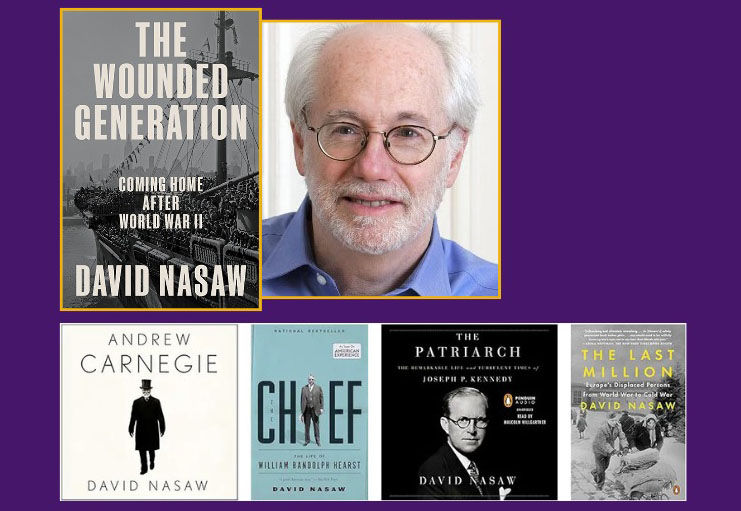
Nasaw’s 2025 non-fiction book, The Wounded Generation: Coming Home After World War II, explores the struggles soldiers faced returning to normalcy after the Second World War.
Nasaw’s book covers the soldiers’ return home, their psychological hardships, the discrimination against Black veterans and women in the U.S. workforce, and the effects of family relations.
The book swaps the title of the “Greatest Generation,” born from 1901 to 1924, for the “Wounded Generation,” replacing the title word to show what was hidden beneath the surface of these individuals.
“Tom Brokaw called the men and women who fought in World War II ‘the greatest generation.’ Turns out this same generation may also have been the most put upon and longest suffering,” said The Wall Street Journal in a review of Nasaw’s book. “PTSD is only one among an Iliad of woes suffered by those who served in combat in World War II and their families who remained stateside. Mr. Nasaw chronicles them all in great detail.”
Along with striking remarks on the hidden decline of veterans’ mental health, Nasaw also includes statistics on the status of soldiers returning home. More than 1 million men were sent home from the armed forces with disability discharges, according to Nasaw in his book. Nasaw also cites statistics on psychiatric impacts during the war, adding that “20 to 34 percent of all nonfatal battle casualties were psychiatric.”
In a recent talk with the National World War II Museum, Nasaw discussed the problems soldiers faced when returning home and trying to assimilate back into the workforce.
“The home front, the politicians and the soldiers themselves were scared to death when they got home that they were going to return to the same Depression that had been cured by the war,” Nasaw said during the talk.
Nasaw has written previously on the aftermath of World War II, focusing on displaced European refugees in Germany in his book The Last Million: Europe’s Displaced Persons from World War to Cold War (2020). His historical publications earned him two Pulitzer Prize nominations, for his biographies Andrew Carnegie (2006) and The Patriarch: The Remarkable Life and Turbulent Times of Joseph P. Kennedy (2013). Nasaw also won the New York Historical Society American History Book Prize for Andrew Carnegie in 2007.
As part of a discussion of his historical non-fiction, Nasaw will sit down with the New York State Writers Institute's Director Paul Grondahl on Thursday, May 7.vStarting at 7:30 p.m. in the Campus Center West Auditorium, Nasaw will discuss The Wounded Generation, answer audience questions and sign copies of his books.
7:30 p.m. Thursday, May 7
Conversation / Q&A
Campus Center West Auditorium
University at Albany
1400 Washington Avenue
Albany NY 12222